
Wilkes County Supervision Types
North Carolina uses three terms that are often blended together. Probation is a court-ordered sentence served in the community, although a violation can lead to a court hearing and confinement. Post-release supervision, often shortened to PRS, begins after many Structured Sentencing prison terms. Parole is conditional release controlled by the North Carolina Post-Release Supervision and Parole Commission and now applies mainly to older sentence structures and specific statutory cases. NCDAC Community Supervision carries out the field work for all three.
The distinction matters when checking a released Wilkes County person. A prison status of inactive does not rule out active supervision. The official NCDAC Offender Public Information search has a separate Active Probationer/Parolee filter. It can retain sentence and supervision history after incarceration ends. A county court case can also show that probation was imposed without a state-prison release.
| Record type | How it begins | Best public check |
|---|---|---|
| Probation | A court orders community supervision | NCDAC active probationer/parolee search and the Wilkes court case |
| Post-release supervision | A qualifying prison term moves into its community phase | NCDAC status and sentence history |
| Parole | The Commission authorizes conditional release in an eligible case | NCDAC status plus the Commission's published review material |
- Discharge
- The formal end of supervision or sentence service, not merely release from a facility.
- Revocation
- An authorized return to custody after a violation process.
- Absconder
- An official supervision status for a person reported as failing to remain in contact, not a casual label for a missed visit.
Check Wilkes County Supervision
Use the state record as the first verification channel. It covers people who have served in a North Carolina prison or participated in state probation, parole, or community supervision. It does not turn a Wilkes County Jail stay into an NCDAC record. When an offender number is known, it provides a stronger match than a common name. Otherwise compare birth date, middle initial, sex, race, sentence county, and correctional history before relying on the result.
- Open NCDAC Offender Public Information and select Active Probationer/Parolee.
- Enter the offender number, or use the narrowest reliable name and identity fields.
- Open the matching record and read the current service and supervision labels exactly.
- Repeat the search under All or Inactive to find earlier prison and supervision history.
- Use the Wilkes court case to confirm the judgment, then contact NCDAC when a current office or status needs direct confirmation.
A state result must be read in sequence. Admission and actual release dates describe custody events. Probation/Parole/Post Release Status describes the community phase. The county of conviction may be Wilkes even when the person reports elsewhere. If the search fails, vary only supported identity fields and use the portal's sounds-like surname option. A no-result does not prove the person has no supervision record.
Wilkes County District 23
NCDAC Community Supervision District 23 groups Wilkes with Alleghany, Ashe, and Yadkin counties. A May 2026 NCDAC announcement said 41 staff supervise more than 1,000 probation, parole, and PRS cases across the four-county district. The release named Lorie Goins as judicial district manager. That is useful operational context, but it is not a person-level lookup and does not establish which officer has a case.
Current street and reporting instructions should be obtained from NCDAC, not copied from an old directory. The research found an older resource listing with prior district information, which shows why office assignments can become stale. Start with the current state locator or the contact shown in the matched offender record. A supervising officer may not disclose protected case details to every caller, but the official record and office can resolve a genuine status or reporting question.
The official District 23 announcement preserves the latest researched management context.
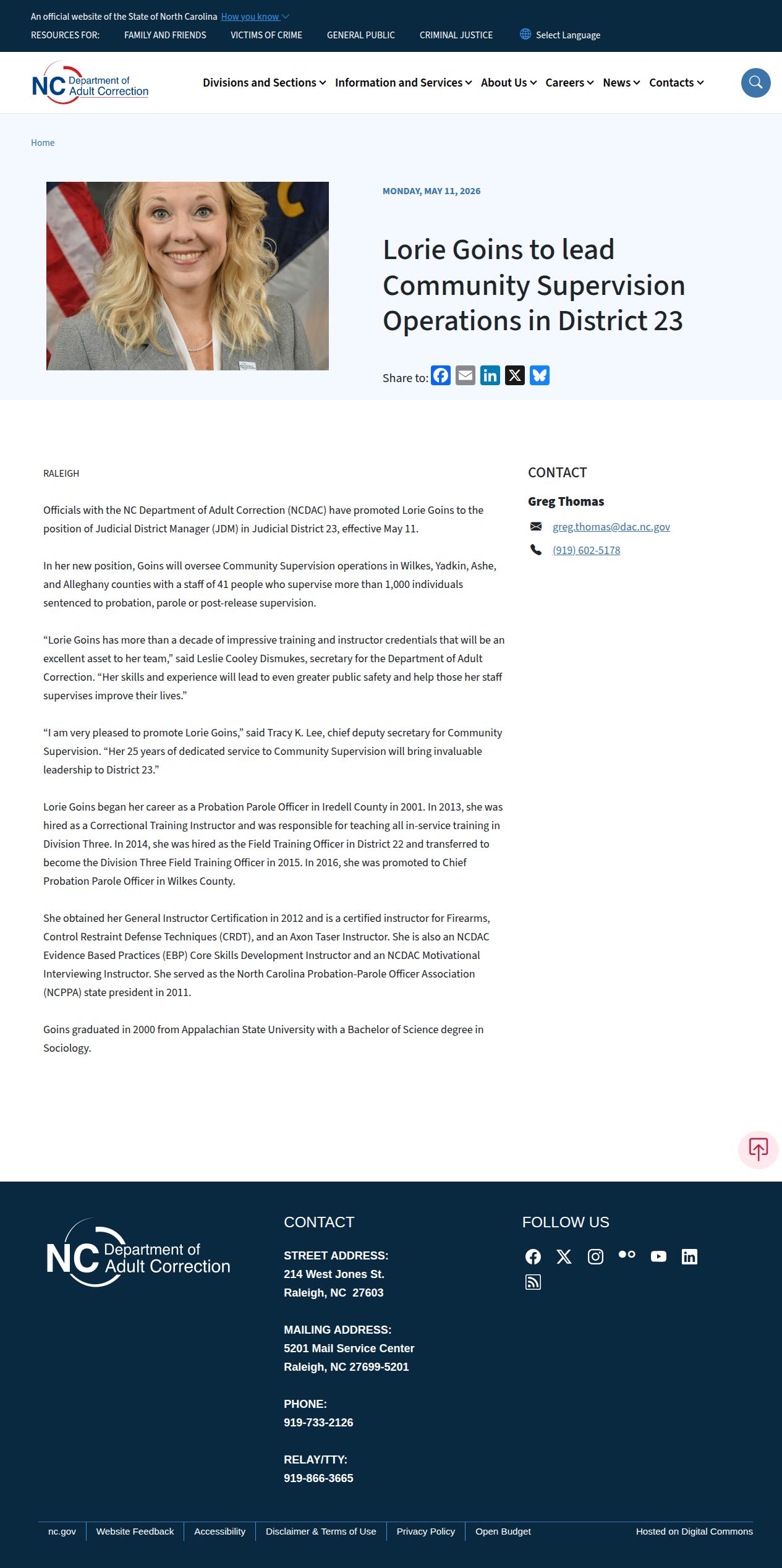
This agency page confirms the four-county district structure; it should not be treated as a roster of supervisees or officers.
Wilkes County Absconder Records
NCDAC maintains a dedicated Absconders search in addition to the main supervision filter. Use it only to check the agency's current public status for a named person. An absconder listing is not proof of a new conviction, present jail custody, or the final outcome of a violation case. It means the supervision agency has formally classified the person as failing to remain in required contact.
If a matching entry appears, compare identity data and offender number with the main NCDAC record. Then check the Wilkes eCourts case for any filed proceeding. An arrest, warrant service, hearing, and revocation are separate events. A person can also return to compliance or custody after a public page was last viewed. Date the information and verify it with NCDAC rather than turning the label into a broader claim.
Note: A missed appointment should never be described as absconding unless the official NCDAC record uses that status.
Wilkes County Parole Decisions
The North Carolina Post-Release Supervision and Parole Commission handles discretionary parole for eligible older-law prisoners and sets conditions where Structured Sentencing makes release to PRS mandatory. North Carolina does not publish a normal individual hearing-date docket. Review is administrative and record based. Eligible people are generally reviewed at least once each year after eligibility, subject to stated exceptions. A majority Commission vote is required.
The public substitute is the Commission's monthly Discretionary Parole Reviews page. Reports have been posted since September 2024. The June 2026 report included OPUS number, identity fields, parole type, decision, denial codes, offense, time served, and sentence imposed. Observed decisions included Approve, Deny, Suspend, and Incomplete. Use the current report legend because those labels can change.
An approval is not proof that a person walked out that day. Release planning and other required steps may remain. Confirm the Actual Release Date and status through OPI, then use NC SAVAN for a reported custody event. The Commission's official overview is visible in the matched capture below.
Traditional parole eligibility depends on the law tied to the offense and sentence, not on a rough count of years served. Structured Sentencing offenses on or after October 1, 1994 generally eliminated traditional parole, while older cases and narrow statutory exceptions remain. Fair Sentencing felony cases from July 1, 1981 through September 30, 1994 can also involve 90-Day Mandatory Parole when the statutory terms are met. “Mandatory” describes that older-law parole type. It does not erase conditions or make the monthly review date a physical release date.
If parole is denied, interested parties may receive the denial and next review timing, but the Commission treats denial reasons and much of its file as confidential. A published monthly report is still useful because it records the Commission's chosen decision vocabulary. It should be cited as a Commission action, then paired with OPI for the custody event and active supervision record.
Open the Commission source page to check current parole material.
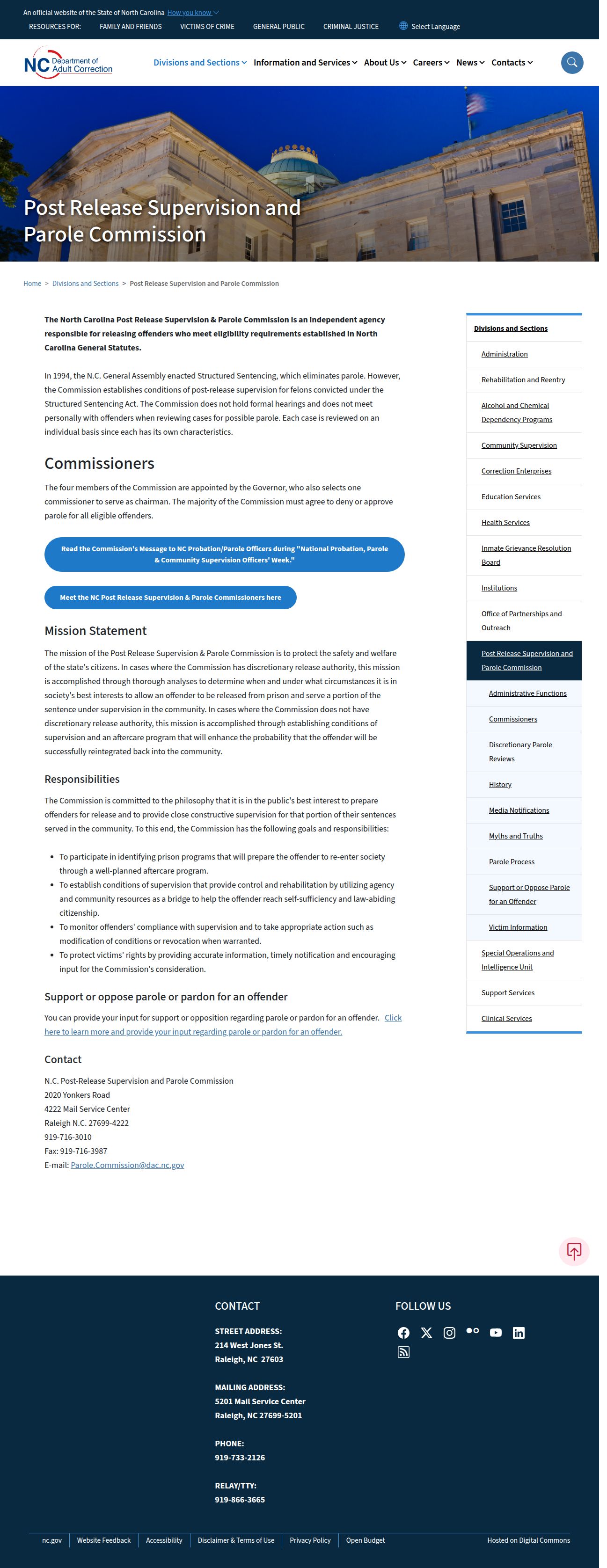
The source shows the responsible state body, while the offender record remains the place to confirm a person's release and supervision status.
Wilkes County Reentry Support
Wilkes Correctional Center has a local role beyond confinement. NCDAC identifies it as a reentry and work-transitional facility for people nearing release. Eligible residents may take part in work release, educational or vocational activity, and transition planning. Daily departure for a work assignment remains part of prison custody. It is not sentence discharge and should not be recorded as a release from NCDAC.
County minutes also document Project Lazarus peer connection around community reentry and a free walk-in recovery center with transportation and peer or wraparound services. Those resources can support continuity after release. They do not verify a release, supervision condition, or discharge. For records, keep the functions separate: NCDAC supplies official custody and supervision status; the Commission supplies its published parole actions; local service organizations help with practical return to the community.
The facility-specific custody route is covered on the Wilkes Correctional Center record page.
Wilkes County Supervision Discharge
Supervision ends through an authorized discharge, not by silence in a jail search. For probation, the court judgment and later case events establish the sentence and any violation action. For parole, North Carolina law allows continuation, modification, revocation, and eventual discharge when statutory conditions are satisfied. PRS also remains part of the sentence until the responsible authority records completion or another outcome.
Build the record from its custodians. Save the current NCDAC result, including offender number and exact status. Obtain the Wilkes judgment or disposition from the Clerk when the court order matters. Use Commission monthly material only for a published parole decision. If an existing public NCDAC record is not available through OPI, the NCDAC records request is the fallback. Basic conviction data, time served, sentence length, admission date, and release date may be public, while other correctional and Commission material can remain confidential.
The full county custody and court verification sequence appears on the Wilkes County released-inmate search page. It helps distinguish a jail exit, prison release, court disposition, and final supervision discharge.